
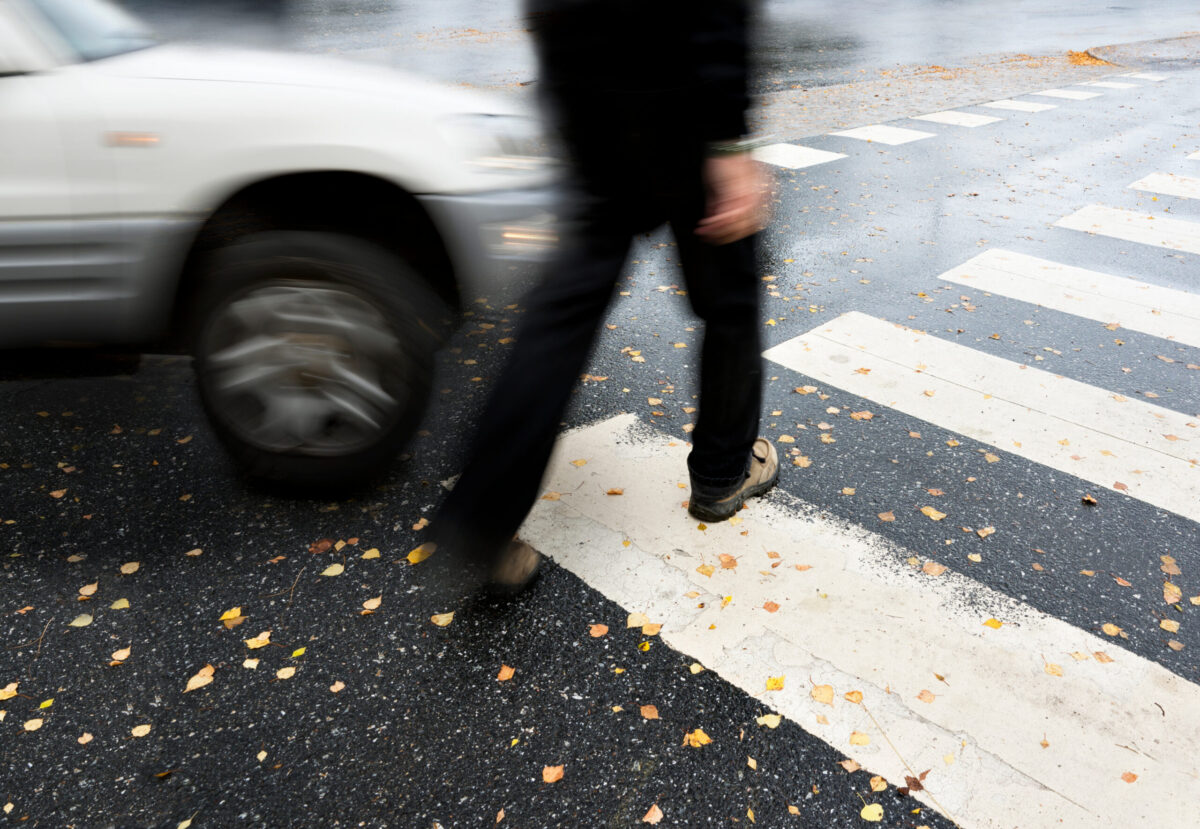
Are Drivers Always at Fault in Florida Pedestrian Accidents?
No, a driver is not automatically at fault just because a pedestrian was hit. Florida law gives drivers a heavy duty of care toward people on foot, and in many crashes the driver is the primary or only party at fault, but fault is decided on the facts of each case. A pedestrian’s own choices can reduce what they recover, and since March 24, 2023, a pedestrian found more than 50 percent at fault can be barred from recovering damages at all.
At the Law Offices of Scott Sobol, we have spent more than two decades representing injured Floridians in pedestrian accident claims and other car accident cases across Broward County and South Florida. Below, we walk through the most common myths we hear about driver fault, and what Florida law actually says about each one.
Time-Sensitive: Florida Law Limits Your Window to File
Most Florida pedestrian injury claims arising on or after March 24, 2023 must be filed within two years of the crash.
More than 20 years handling South Florida injury claims. Free consultation. Contingency fee representation.
Myth 1: The Driver Is Always at Fault When a Pedestrian Is Hit
There is a reasonable intuition behind this belief. Drivers operate heavy machinery capable of causing catastrophic injury, and Chapter 316 of the Florida Statutes requires every driver to exercise due care to avoid colliding with any pedestrian, to stop for pedestrians in crosswalks when required, and to use extra caution around children and people who appear confused or incapacitated. In many accidents, the driver is indeed the primary or sole at-fault party.
But Florida’s legal system does not operate on assumptions. Fault is determined by examining the specific facts of each case, and those facts do not always point exclusively at the driver. Pedestrians, like everyone else on Florida roadways, have their own legal obligations. When a pedestrian fails to meet those obligations and that failure contributes to the crash, it can change the outcome of a personal injury claim in meaningful ways.
Myth 2: Florida Still Lets You Recover No Matter How Much You Were at Fault
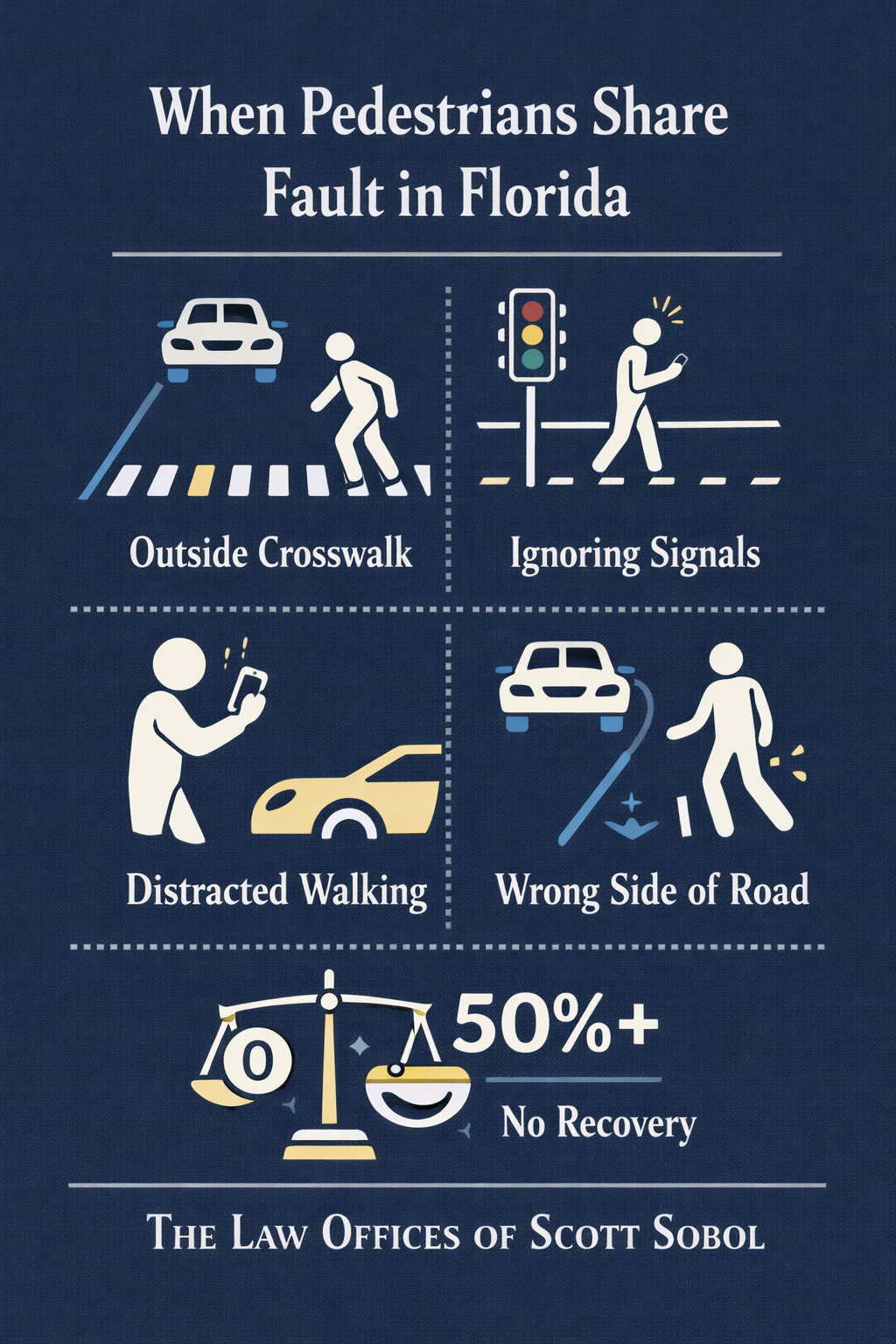
This one used to be true. Before March 24, 2023, Florida followed pure comparative fault, which allowed an injured person to recover something even when they were 99 percent responsible. House Bill 837 changed that. Florida now follows a modified comparative negligence standard under section 768.81(6), which says a party found greater than 50 percent at fault for their own harm may not recover any damages.
When fault is shared and the pedestrian stays at or below the 50 percent line, their recovery is reduced by their share of responsibility. As a simple hypothetical, a pedestrian found 30 percent at fault in a crash that caused $200,000 in damages would recover $140,000 rather than the full amount. The same pedestrian found 51 percent at fault would recover nothing from the driver. That is why the stakes of establishing fault correctly are much higher than they were a few years ago. Our guide to how Florida’s modified comparative negligence law affects car accident claims explains the rule in more depth, and our post on how pedestrian comparative fault and PIP benefits apply walks through how the fault percentage and your no-fault coverage work together.
Myth 3: If I Was Not in a Crosswalk, I Have No Case
Crossing outside a crosswalk matters, but it does not end a claim. Under section 316.130, a pedestrian crossing anywhere other than a marked crosswalk or an unmarked crosswalk at an intersection must yield the right-of-way to vehicles, and between two adjacent intersections with working traffic signals, pedestrians may cross only in a marked crosswalk. At the same time, the statute keeps the driver’s duty of due care in place everywhere on the road.
Crossing Outside a Designated Crosswalk
Pedestrians who cross mid-block or step out between parked vehicles may be found partially responsible for a collision. While drivers are still obligated to exercise reasonable care and avoid striking pedestrians anywhere on the road, a pedestrian who suddenly leaves a curb or other place of safety and walks or runs into the path of a vehicle that is too close to stop may be assigned a significant share of the fault, since Florida law specifically prohibits that conduct.
Distracted Walking
Pedestrians who step into traffic while looking at a phone, wearing headphones that block surrounding sound, or otherwise not paying attention may be found to have contributed to the accident. Florida law expects pedestrians to exercise reasonable care for their own safety, and insurers often look for phone records or video to make this argument.
Walking While Impaired or Hard to See
A pedestrian who enters the roadway while intoxicated may be found to have contributed to a crash, since impairment can affect judgment about traffic gaps, signals, and approaching vehicles. Insurers also sometimes point to dark clothing at night or a poorly lit crossing point to argue that a pedestrian did not take reasonable precautions for their own safety. These are factual arguments, not automatic findings of fault, and they are weighed against what an attentive driver traveling at a safe speed could have seen and done.
Walking Along Roadways
Where sidewalks are not provided, section 316.130 directs pedestrians, when practicable, to walk only on the left shoulder, facing oncoming traffic. Failing to follow this rule, particularly at night or in low-visibility conditions, can become a factor in fault analysis. None of these situations automatically makes the pedestrian more than 50 percent at fault. They are arguments an insurer may raise, and the driver’s speed, attention, and reaction still get weighed against them.
Myth 4: Pedestrians Always Have the Right-of-Way
Pedestrians often do have the right-of-way, especially in crosswalks with a walk signal, but Florida law also requires them to obey traffic control signals and to yield in the situations described above. Crossing against a “Don’t Walk” signal is one of the fault arguments we see most often. Our post answering whether Florida pedestrians always have the right-of-way breaks down exactly when the right-of-way shifts.
Myth 5: The Police Report Decides Who Was at Fault
A police report is an important piece of evidence, and an officer’s citation can influence how an insurance adjuster views a claim. It is not a legal ruling, though. Under section 316.066, the crash report and statements made for it generally cannot be used as evidence at trial, and insurers and courts weigh all of the evidence independently. Our guide to the role of a police report in a Florida car accident claim explains what the report can and cannot do for you.
Myth 6: If the Driver Was Negligent, My Own Actions Do Not Matter
Even in cases where a pedestrian made an error in judgment, the driver may still carry the majority of fault. Drivers have an elevated duty of care precisely because of the harm their vehicles can cause, and several common driver behaviors are treated seriously under Florida law. The reverse is also true, though. A driver’s negligence does not erase evidence of what the pedestrian did, which is why both sides of the story need to be documented.
Distracted driving, including texting, adjusting a GPS, or talking on the phone, is a leading cause of pedestrian accidents and is viewed as a significant breach of a driver’s duty. Our post on how to prove the other driver was distracted covers the evidence that usually supports this argument. Speeding, particularly in school zones, residential areas, or near crosswalks, reduces a driver’s ability to stop in time and increases the severity of impact. Failure to yield at marked crosswalks, running red lights, and driving under the influence of alcohol or drugs are all circumstances where driver fault is likely to be dominant or exclusive. When driver negligence is the main cause of a crash, an injured pedestrian may be able to seek compensation for medical expenses and lost income beyond what PIP pays, and, when the injury meets Florida’s permanent-injury threshold, for pain and suffering, with any recovery reduced by the pedestrian’s own share of fault. Our post on what compensation pedestrians can seek after being hit by a car in Florida covers these damages in more detail.
Accidents involving large commercial vehicles carry their own additional legal considerations. Pedestrians struck by delivery trucks, semi-trucks, or other commercial vehicles may have claims not only against the driver but also against the employer. Our team handles truck accident cases and understands how to investigate the layers of liability involved in these situations.
Myth 7: If the Driver Fled, There Is No One to Pay
A hit-and-run does not eliminate an injured pedestrian’s ability to recover compensation. Your own Personal Injury Protection (PIP) coverage, or the PIP of a relative you live with, may pay a portion of medical bills and lost income regardless of fault. Uninsured motorist coverage on your own auto policy, if you carry it, may also apply when the driver cannot be identified. Our post on what happens when you are hit by a driver who flees the scene covers these options in more detail.
Identifying the at-fault driver remains a priority in these cases, and early investigation, including surveillance footage, witness accounts, and debris analysis, can be critical. This is one of many reasons why involving an attorney as soon as possible after a pedestrian accident is so important.
Myth 8: I Have Plenty of Time to Decide Whether to File
House Bill 837 also shortened the statute of limitations for most negligence claims in Florida. Under section 95.11, Florida Statutes, a negligence action arising on or after March 24, 2023 generally must be filed within two years, down from the four years that applied before. Wrongful death claims are also subject to a two-year deadline, measured from the date of death.
Two years can pass quickly while you are recovering, and evidence such as traffic camera footage may be overwritten within days or weeks. Missing the filing deadline generally ends the claim permanently, so it is wise to speak with an attorney well before it approaches.
What to Do After a Pedestrian Accident in Florida
The steps taken in the hours and days after a pedestrian accident can have a lasting impact on a claim. Seeking medical attention immediately is the most important first action, both for your health and because prompt medical documentation establishes a clear connection between the accident and your injuries. It also matters for insurance, since Florida PIP benefits generally require initial treatment within 14 days of the crash.
Avoid giving recorded statements to any insurance company, including your own, before speaking with an attorney. Insurers are skilled at asking questions in ways that can be used to assign you a greater share of fault and reduce what they owe. Florida’s modified comparative fault rule means that every percentage point of assigned blame has real financial consequences. The same caution applies at the scene itself: apologizing to the driver or discussing who was at fault can later be used to argue that you share the blame.
Gathering evidence at the scene, if you are physically able to do so, is also valuable. Calling 911 so that police respond and prepare a crash report creates an early record of the scene, even though, as noted above, the report itself is not the final word on fault. Photographs of the location, signals, vehicle damage, road conditions, and any visible injuries, along with names and contact information for witnesses, can all support your case. If you were visiting Florida when you were hurt, our post on pedestrian accidents in Florida tourist areas covers the extra steps visitors should take.
Contact the Law Offices of Scott Sobol
Pedestrian accident cases require careful investigation and a thorough understanding of how Florida’s fault rules apply to your specific situation. Whether the driver was clearly negligent, fault is disputed, or you are worried that something you did contributed to the crash, you deserve legal counsel who will look at the full picture and pursue the recovery your claim supports. Scott Sobol has represented injured clients throughout South Florida for more than 20 years, has handled cases in circuit courts across the region, and is admitted to practice in Florida, Illinois, and Texas.
Our firm handles personal injury cases on a contingency fee basis, meaning you generally pay no attorney’s fee unless your case results in a recovery. To speak with our team about your situation, use our contact form to schedule your free consultation today.
Every case is different. Past results and prior experience do not guarantee a similar outcome in any future matter, and this article is general information rather than legal advice for your specific situation.
Frequently Asked Questions About Driver Fault in Florida Pedestrian Accidents
Can a pedestrian be found completely at fault for being hit by a car in Florida?
Yes, in some circumstances. If a pedestrian suddenly steps into the path of a vehicle that has no reasonable chance to stop, or crosses against a signal on a high-speed road, a jury may place most or all of the fault on the pedestrian. If the pedestrian is found more than 50 percent at fault, Florida law bars recovery of damages from the driver.
What percentage of fault bars a pedestrian from recovering in Florida?
Under section 768.81(6), a person found greater than 50 percent at fault for their own injuries cannot recover damages in most negligence cases. At 50 percent or less, the recovery is reduced by the pedestrian’s share of fault. This rule applies to claims governed by the March 24, 2023 tort reform law.
Does a driver still have a duty to avoid me if I was jaywalking?
Yes. Florida law requires every driver to exercise due care to avoid colliding with any pedestrian, even one who is crossing outside a crosswalk. Jaywalking may shift some fault to the pedestrian, but a speeding, distracted, or impaired driver can still carry most of the responsibility.
What evidence helps show that a driver was at fault for hitting a pedestrian?
Useful evidence often includes traffic camera, surveillance, or dashcam footage, witness statements, phone records that may show the driver was distracted, and physical evidence such as skid marks, vehicle damage, and the point of impact. In disputed cases, an accident reconstruction expert may analyze speed, sight lines, and timing. Because video can be overwritten within days or weeks, it helps to request it as early as possible.
Who pays my medical bills if the driver who hit me fled the scene?
Your own PIP coverage, or the PIP of a relative you live with, may cover a portion of medical bills and lost income regardless of fault, as long as you seek initial treatment within 14 days. Uninsured motorist coverage on your policy may also apply if the driver is never identified or has no insurance.
How long do I have to file a pedestrian accident lawsuit in Florida?
For most negligence claims arising on or after March 24, 2023, Florida’s statute of limitations is two years from the date of the crash. Wrongful death claims also have a two-year deadline from the date of death. Some claims have different rules, so it is best to confirm your deadline with an attorney early.

LEGALLY REVIEWED BY:
Scott Sobol
October 10, 2026
Recent Posts

You did everything right after your accident. You called the police, exchanged information at the scene, and gave a truthful stateme ...
A car accident can turn your life upside down in a matter of seconds. Between hospital visits, missed paychecks, and phone calls fro ...
Can You Still Recover Compensation If the At-Fault Driver Has No Bodily Injury Coverage in Florida? - 08/18/26
A car crash is stressful enough before you find out the other driver has almost no insurance at all. Many people assume that if some ...
